
Best Flooring Types for Indoor Rabbits
What makes indoor flooring actually usable for rabbits: traction, continuous coverage, rug edges, movable mats, cleaning, hard floors, foam mats and the way rabbits use a room.
Indoor flooring starts to matter as soon as a rabbit has enough room to move around.
A room can be large while the rabbit still spends most of its time on one rug. Hay may be only a short distance away, yet the rabbit stretches from the rug edge instead of crossing the smooth floor. Some rabbits lower their bodies and move cautiously on wood or tile, then start moving normally again as soon as they reach carpet.
Rabbits do not have the same obvious paw pads as cats and dogs. Their feet are covered in fur, so very smooth surfaces can give them less grip, especially when they accelerate, turn or stop.
That means the floor area of a room and the floor area a rabbit is comfortable using are not always the same thing.
A floor only becomes useful living space when the rabbit can walk, run and stop on it naturally.
Smooth floors mostly become a problem when the rabbit cannot get stable footing
Rabbits vary a lot on smooth floors.
Some walk normally and only slip occasionally when they run. Some move carefully all the time. Others barely leave the rug at all.
Tile, polished wood and some laminate floors are more likely to feel slippery, but the material name alone does not tell the whole story. Different finishes can have very different levels of grip, and rabbits also differ in size, foot fur and confidence.
If a rabbit walks across a surface naturally, can stop and turn without sliding, and chooses to use it on its own, that area may not need to be covered simply because it is made of wood or another hard material.
If the rabbit consistently avoids a large section of the room, that floor is adding very little to its real living space.
Small rugs can turn into separate landing spots
Putting down one rug often changes a room immediately.
A rabbit that had been staying close to the wall may start resting on the rug and moving more freely as soon as it has a surface with better grip.
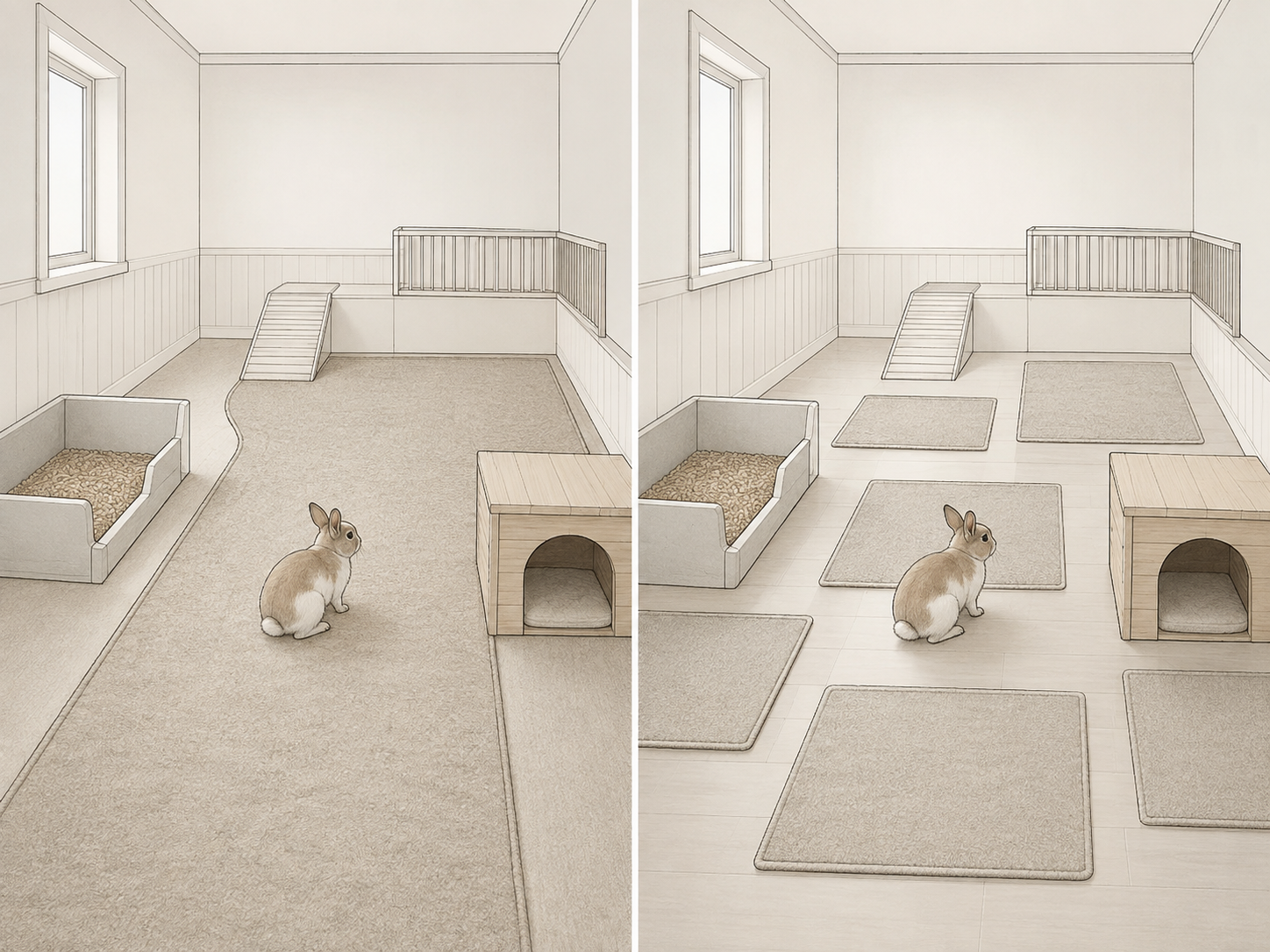
Several small rugs do not always connect the room in the same way. Some rabbits treat them like separate islands, hopping from one to another while still avoiding the smooth floor in between.
The room may look well covered, but the route the rabbit can comfortably run through is still broken.
A longer runner or a larger rug that covers the main path often works better. When the litter area, hay, resting places and the main open floor are connected by stable footing, movement tends to become much more natural.
A rug does not need to be especially thick to work well
Softness is easy to notice when choosing a rug, but rabbits often benefit more from stability.
Long pile, loose loops and fibres that can be pulled out give some rabbits obvious places to start chewing or tugging. A single loose thread can turn into a much larger section once it is repeatedly pulled.
Very loose surfaces can also catch toes or nails more easily.
Low-pile rugs with a fairly tight surface tend to be simpler. They do not need to feel hard. They only need to stay stable underfoot and avoid presenting lots of loose material that invites constant attention.
A useful rabbit rug is often one the rabbit barely needs to notice: stable underfoot, with very little to pull apart.
Rug damage often begins at the edge
The centre of a rug may stay untouched while one corner becomes a favourite digging spot.
A lifted edge, a loose thread or an exposed seam gives the teeth something to hold. Once the rabbit pulls it, the edge loosens further and the backing or underlayer begins to show.
A small corner can gradually turn into a regular chewing and digging point.
Placement makes a difference here.
The same rug may be ignored when one side sits under furniture and the remaining edges lie flat. Put it in the middle of the room with every edge exposed and there are many more places to start pulling.
This is one reason simple low-pile runners can work surprisingly well in rabbit rooms. They are easy to lay flat and their edges are easier to keep tidy.
The litter area and the main activity area do not have to use the same floor
A rabbit room does not need one material from wall to wall.
The floor around the litter and hay area deals with different things from the middle of the room. Hay falls there every day. Water may spill. A small amount of damp litter or wet hay occasionally ends up outside the box.
A large rug that is difficult to wash can become inconvenient in that spot.
The main activity area benefits from a large, stable surface, while the litter area can use something smaller that is easy to lift and clean. When it gets dirty, only that section needs to be washed or replaced.
The result may look less uniform than a single floor covering, but it often works better in ordinary daily use.
Foam mats work very differently depending on whether the rabbit tries to chew them
Interlocking foam mats are easy to understand as a flooring solution. They are inexpensive, quick to lay down and can add grip over tile or smooth wood.
Some rabbits live on them for years without showing much interest.
Others find the seams and exposed edges almost immediately. Foam takes tooth marks easily, and once a corner has been opened up it becomes easier to keep pulling pieces away.
At that point the issue is no longer only whether the floor is non-slip. The rabbit is treating the flooring itself as something to chew.
A mat that stays intact and is ignored by the rabbit can be quite practical. A mat that is repeatedly torn apart or swallowed is a different situation.
This is why one flooring material can work perfectly in one home and fail immediately in another.
A mat can have good grip and still slide across the floor
Some mats feel grippy on top but are very light.
On a smooth floor, the rabbit may not slip against the mat at all. Instead, the whole mat moves when the rabbit runs onto it.
This is easy to miss during slow walking and much more obvious during a sudden sprint, sharp turn or binky.
Small, thin mats are especially prone to moving.
Larger rugs with some weight, or mats with a stable underside, tend to stay in place more reliably. If several pieces are used together, the joins can also shift as rabbits run across them.
Floor stability has two layers
| Contact point | What needs to stay stable |
|---|---|
| Rabbit's feet → surface | The feet should not slide outward during normal movement. |
| Rug or mat → original floor | The whole covering should not move with the rabbit. |
A surface can feel non-slip in the hand and still be unstable once it is laid over a smooth floor.
Tile can still be useful as a resting surface
Tile is often too slippery to make a good main running surface, but it has another quality rabbits sometimes use deliberately: it stays cool.
In warm weather, some rabbits leave the rug and stretch out on exposed tile for a while before returning to the softer area.
The same surface can therefore be poor for running and useful for resting.
Once the main routes already have stable footing, a small hard-floor area does not always need to disappear. If the rabbit chooses to use it comfortably, it can remain part of the room.
The same applies to wood flooring. Areas where the rabbit moves naturally can stay uncovered. Areas that consistently cause hesitation or slipping can be covered instead.
The final room does not need to look uniform.
Two rabbits make unstable patches easier to notice
One rabbit often develops a fairly predictable route through a room.
With two rabbits, movement becomes less orderly. One may suddenly run and the other follows. They cross paths, turn in different directions and use the room more quickly.
Small isolated mats and short stretches of slippery flooring are more likely to be encountered during that kind of movement.
Continuous stable coverage becomes more useful in a shared space for exactly that reason. It is not about doubling the amount of carpet. It is about reducing sudden changes in footing along the routes the rabbits actually use.
Cleaning and traction can be handled in different parts of the room
Rabbit areas need regular cleaning.
A fully waterproof hard surface is easy to wipe, but if it is too slippery for normal movement, it does not work well as the only floor in the main activity area.
Different parts of the room can do different jobs:
- Litter and water area
- favour easy cleaning.
- Main running area
- favour stable footing.
- Regular resting places
- can be softer.
- Small cool hard-floor area
- can remain available in warm weather.
This kind of mixed floor is not visually perfect, but it fits the way indoor rabbits actually use a room.
Machine-washable small mats, vacuum-friendly low-pile rugs and longer runners are often enough to handle most everyday mess without sacrificing stable movement.
Rabbit flooring usually gets better through small adjustments
It is easy to want to buy one complete flooring solution at the beginning.
In practice, the room often changes after the rabbit has lived on it for a while.
A small mat keeps moving, so it gets replaced with something heavier. One rug corner is constantly lifted, so the edge is secured or the rug is changed. The litter area gets dirty too often, so a washable mat is added there. In summer, the rabbit starts using one exposed patch of tile as a cool resting place.
The final room may contain a large rug, a runner, a washable mat and a little hard flooring.
It is less tidy as a single “best flooring” answer, but it often works much better in real life.
If the rabbit willingly uses the floor, can run without losing footing, does not spend its time dismantling the material, and the area can still be cleaned without too much trouble, the floor is already doing its job well.