



How Much Space Does an Indoor Rabbit Really Need?
A practical look at indoor rabbit space: minimum size, continuous floor area, free-roam setups, flooring, shared space and what actually makes a room usable.
“How much space does a rabbit need?” sounds like a question that should have one simple number.
In an indoor home, the number only tells part of the story. Two spaces can have the same floor area and still feel completely different to a rabbit. One may leave enough room to run, turn, stretch out and move between different areas. Another may be broken up by furniture, narrow gaps and barriers until very little of the floor is actually useful.
Rabbits use continuous, usable space - not the total area shown on a floor plan.
Fitting the rabbit in is not the same as giving the rabbit room to live
The problem with a small cage is not only that it looks cramped when the rabbit lies down.
Rabbits repeatedly get up, change position, hop, run, stretch out and stand upright during the day. They may suddenly accelerate for a short distance and then settle somewhere else. A living area needs to make those movements possible without everything being packed into the same tiny footprint.
A space can hold a litter box, water, hay and a hideout and still be too small to function as a proper living area.
This is especially obvious with traditional rabbit cages. Everything technically fits inside, but the rabbit may only be able to take one or two steps between the litter box and hay before reaching the other side.
Indoor setups now more often use a larger pen, a dedicated rabbit zone or a rabbit-proofed room, with any smaller enclosure acting more like a base or resting area than the rabbit's entire world.
The “continuous” part of 3 m × 2 m matters
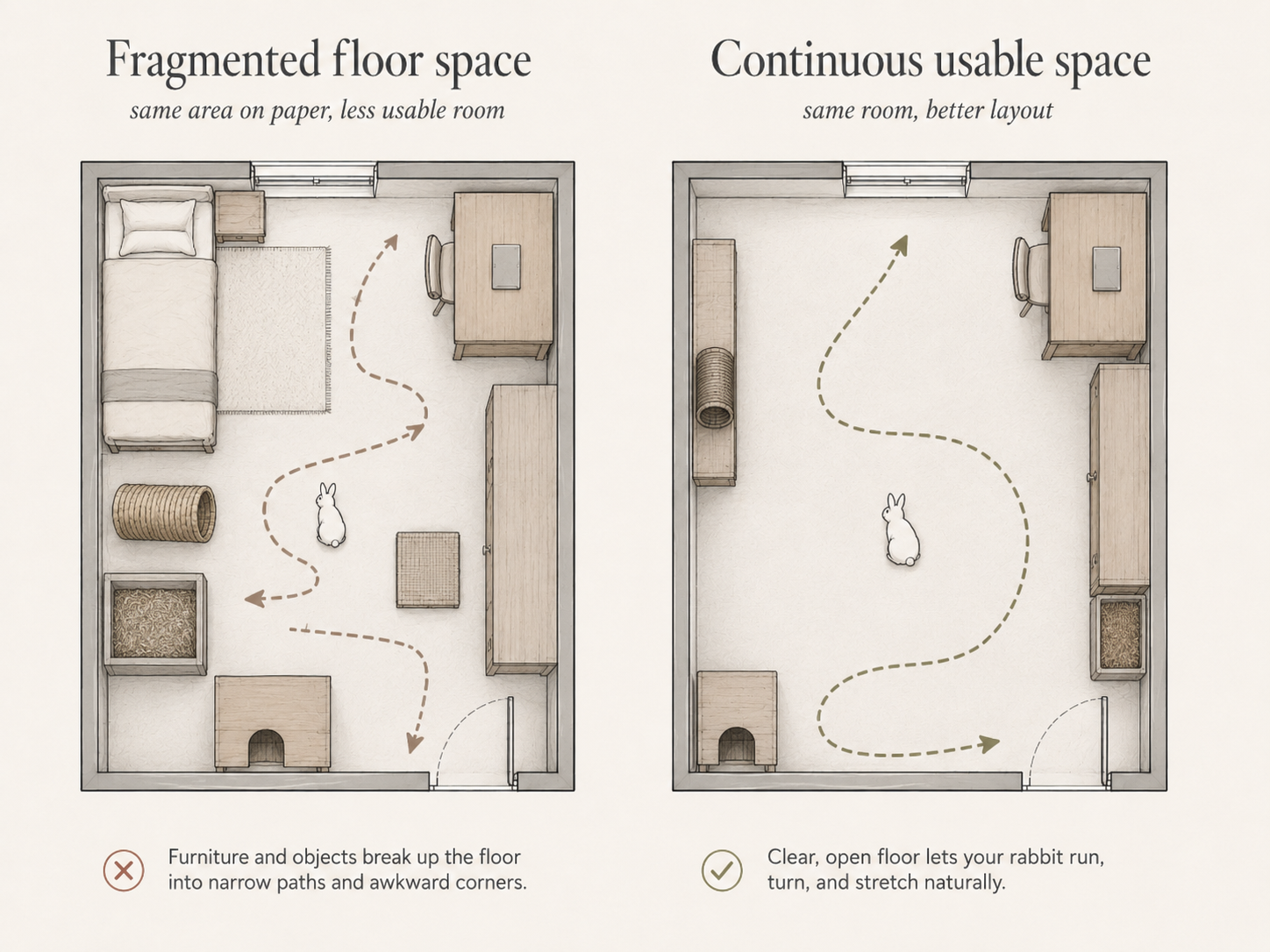
Two layouts can have the same area on paper and work very differently.
A narrow shape with several turns may add up to six square metres, but the rabbit may still only be able to hop forward a few times before turning back.
A more open block of floor allows actual running.
That is why the 3 m × 2 m benchmark is usually discussed as one continuous footprint rather than a collection of disconnected pieces. Platforms, tunnels and upper levels can make the environment more interesting, but they do not replace the basic floor area needed for movement.
The same thing happens inside a bedroom.
A room may be fairly large, but if a bed takes up the centre, the remaining space is a thin path along the walls, and the far side is blocked by a desk and storage boxes, the rabbit's real running space may be much smaller than the room itself.
A slightly smaller room with furniture pushed to the edges can sometimes work better because it leaves one clear route through the middle.
Free-roam does not have to mean the whole house
The phrase “free-roam rabbit” can make it sound as though the rabbit needs unrestricted access to an entire home.
That is not the only way indoor housing can work.
Some rabbits live in a whole bedroom. Some have a dedicated section of a living room. Others have a large x-pen as a permanent base that opens into a wider rabbit-proofed area.
The useful part of free-roam is not the number of rooms the rabbit can enter. It is having a large enough, safe area that remains available for normal movement instead of only becoming accessible at certain times.
A large pen that stays open and already allows running, resting, eating and hiding is very different from a small cage that only becomes usable once the rabbit is let out for a few hours.
A few hours of exercise do not fully make up for a tiny home base
Rabbits do not only feel like moving when it is convenient for people.
Their activity rises and falls throughout the day, and many are especially active around dawn, dusk and during parts of the night. If the larger exercise area is only available when someone opens a door, the rabbit's movement has to follow the household schedule.
That is why “the cage is small, but the rabbit comes out for three or four hours every day” is not the same as having a usable living area all day.
Extra access to a room is still valuable. The difference is that the base space should already allow normal movement, while the extra area adds to it rather than compensating for it.
Filling the area with rabbit furniture can shrink it again
Rabbit areas tend to collect a lot of things: a litter box, hay, water, hideouts, tunnels, toys, mats, steps and cardboard boxes.
All of those can be useful, but too many of them can slowly take over the very floor space they were meant to enrich.
Sometimes a simpler room works better.
The litter-and-hay area can stay together on one side, a hideout can sit somewhere quieter, and the middle or one long route through the room can remain open. Toys do not all have to be on the floor at the same time.
A less crowded setup may look plainer in photos, but it can give the rabbit more room to move naturally.
A slippery floor can make a large room feel much smaller
This is particularly common indoors.
A room may have plenty of floor area, but most of it is smooth tile, polished wood or slippery laminate. If the rabbit's feet keep sliding, the rabbit may simply avoid using that part of the room.
So “usable space” and “floor area” are not always the same thing.
10 m² room
on the floor plan
2 m² rug
actually used comfortably
If the rabbit rarely leaves the rug, the comfortable living area may effectively be closer to those two square metres.
Large rugs, stable low-pile mats or other non-slip surfaces can completely change how a rabbit uses a room.
Space for two rabbits is not simply “single-rabbit space × 2”
The common 3 m × 2 m benchmark is already intended for a pair of average-sized rabbits. It is not six square metres per rabbit.
Two rabbits often rest together, eat hay together and may even squeeze into the same litter box. At the same time, they also need enough room not to be on top of one another all day.
One rabbit should be able to lie down without blocking the whole route. If one rabbit is inside a hideout, the other should still have somewhere comfortable to go. If both suddenly start running, the space should not immediately turn into a collision course.
In a shared setup, look for
- more than one comfortable resting place;
- enough access around hay and water that one rabbit is not constantly in the way;
- hideouts with enough space and preferably more than one exit;
- somewhere for one rabbit to move away when it wants a little distance.
This is not the same thing as simply adding another litter box or another bed.
Vertical space is useful, but it does not replace running space
Platforms, low steps and small upper levels can be very useful.
Some rabbits enjoy sitting slightly higher up to look around, and many will happily jump onto and off a low platform. It adds another kind of movement to the room.
What it does not do is make the ground-level running route any longer.
A two- or three-level rabbit condo may look large when all the floors are added together, but it is not equivalent to one equally large continuous floor area.
Platforms work best as extra space rather than a way to shrink the basic footprint.
A small home does not automatically mean a small cage
Indoor rabbit homes often have to fit into apartments, bedrooms and shared living spaces. Not everyone has a spare room.
In smaller homes, the way space is arranged can matter more than trying to create a separate “rabbit room.”
A large pen can sit against a wall instead of occupying the middle of the room. The litter and hay area can stay in one corner. A pen door can remain open into a rabbit-proofed section of the room. If the space under a bed is not safe or useful, it can be blocked off instead of being counted as extra rabbit space.
Sometimes moving one piece of furniture creates more usable room than adding another piece of rabbit furniture.
When space is limited, protecting one clear route that the rabbit can actually run through is often more useful than filling the room with more things.
So how much is “enough”?
The 3 m × 2 m continuous-space benchmark is still a useful minimum reference for two average-sized rabbits, with about 1 m of height available. But the number only becomes meaningful when the floor actually works as living space.
Larger rabbits, particularly active rabbits, or rooms that need to hold more equipment may need more breathing room.
Once rabbits are actually living in the space, check
- Can they run more than a few steps?
- Is there somewhere to accelerate?
- Does one rabbit lying down block the main route?
- Can two rabbits rest in different places?
- After the litter box, hay area and hideouts are in place, is there still a real open area left?
When those things happen naturally, the space starts to function like a home rather than a container that happens to fit all the rabbit supplies.
Sources and Further Reading
- Rabbit Welfare Association & Fund - Space Recommendations
- Rabbit Welfare Association & Fund - Indoor Rabbit Housing
- RSPCA - Creating a Good Home for Rabbits
- RSPCA - Keeping Rabbits in Your Home
- PDSA - Creating the Ideal Home for Your Rabbits
- PDSA - Keeping Indoor Rabbits
- Rabbit.org Foundation - Living Space: How to Set It Up
- Rabbit.org Foundation - Exercise: Setting Up Playgrounds