
How to Set Up a Litter and Hay Area for Indoor Rabbits
A practical, safety-first guide to choosing a litter box, placing hay, reducing mess and adapting the setup to your indoor rabbit.
For indoor rabbits, the litter box and hay area usually work best together. Many rabbits naturally eat hay while toileting, so keeping hay in the litter box, beside it, or close enough that the rabbit can eat while standing inside the box is often more practical than separating the two areas completely. A good setup, however, is more than a small litter tray and a hay bag: box size, hay access, hygiene, feeder design and the way your own rabbit uses the space all matter.
Start With a Litter Box That Is Truly Large Enough
Many triangular trays sold specifically for rabbits are simply too small for an adult rabbit.
A useful practical standard is simple: your rabbit should be able to get fully inside, turn around easily and lie down comfortably. If you have enough space, a little extra room is better than choosing a box that only just fits the rabbit's body.
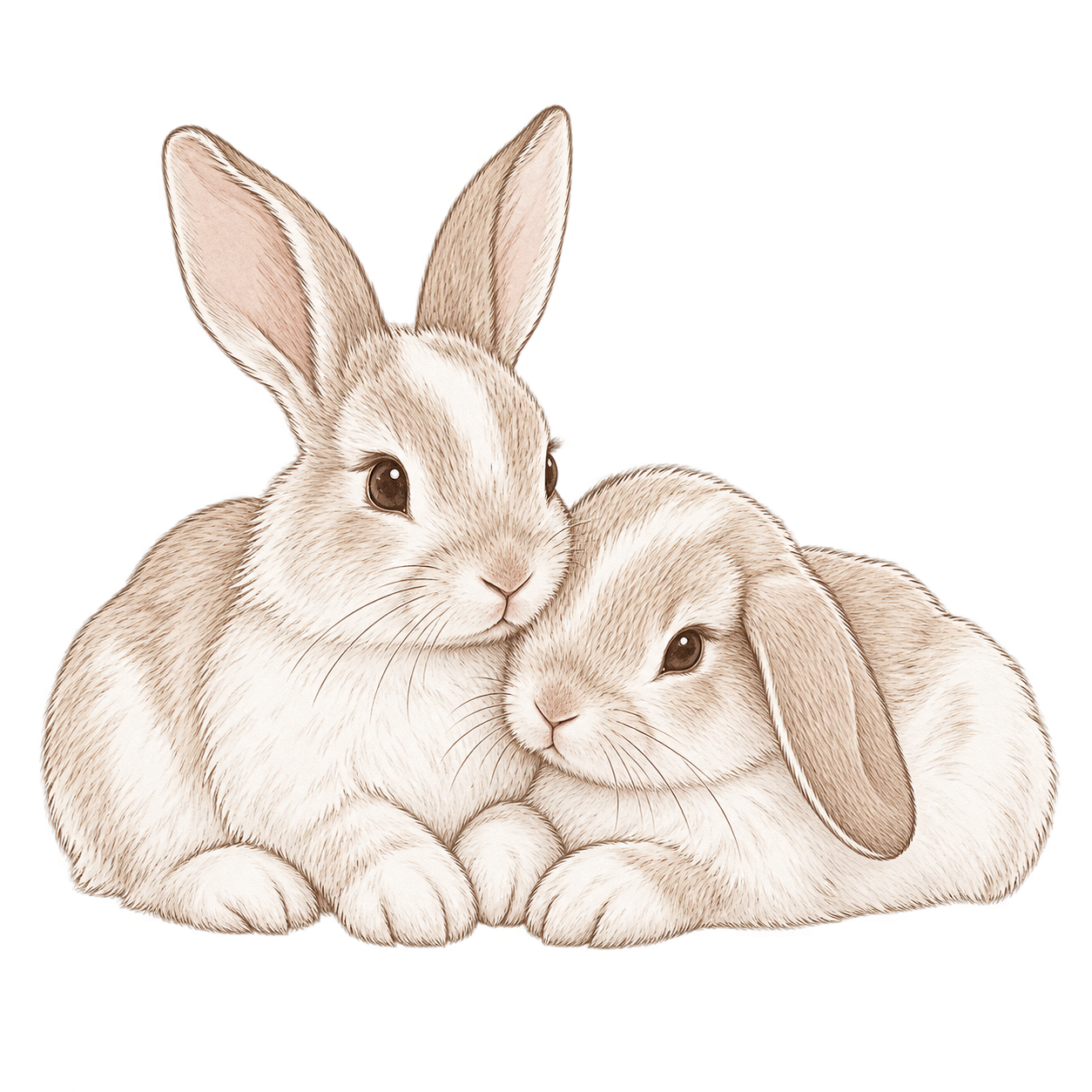
This becomes even more important with bonded rabbits. Many pairs like to sit in the litter box together while eating hay, so a box chosen for only one rabbit may quickly become too small.
Large cat litter pans and low-sided storage boxes are often more practical than very small products marketed specifically for rabbits.
Put the Litter Box Where Your Rabbit Already Wants to Go
If your rabbit keeps urinating in the same corner, it is usually easier to try moving the litter box there than to keep insisting on a location that looks better to you.
Rabbits often choose regular toilet areas naturally. This is especially noticeable during litter training or when a rabbit is first given more free-roam space. Watching where your rabbit already prefers to go and adjusting the tray around that habit is often easier than forcing a predetermined layout.
When introducing a new litter box, placing a few droppings or a small amount of urine-scented litter inside can also help your rabbit recognize what the new area is for.
Indoor rabbit setups often work best this way: start with a sensible arrangement, watch how your rabbit actually uses the room, and adjust from there.
There Is No Single Perfect Way to Offer Hay
There is no single answer to whether hay should be offered loose or in a feeder. Some rabbit-welfare guidance favors low or floor-level loose hay because it supports a natural feeding posture and allows rabbits to forage and sort through the hay. Other guidance notes that a feeder near the litter area can reduce contamination and make it convenient for rabbits to eat while toileting.
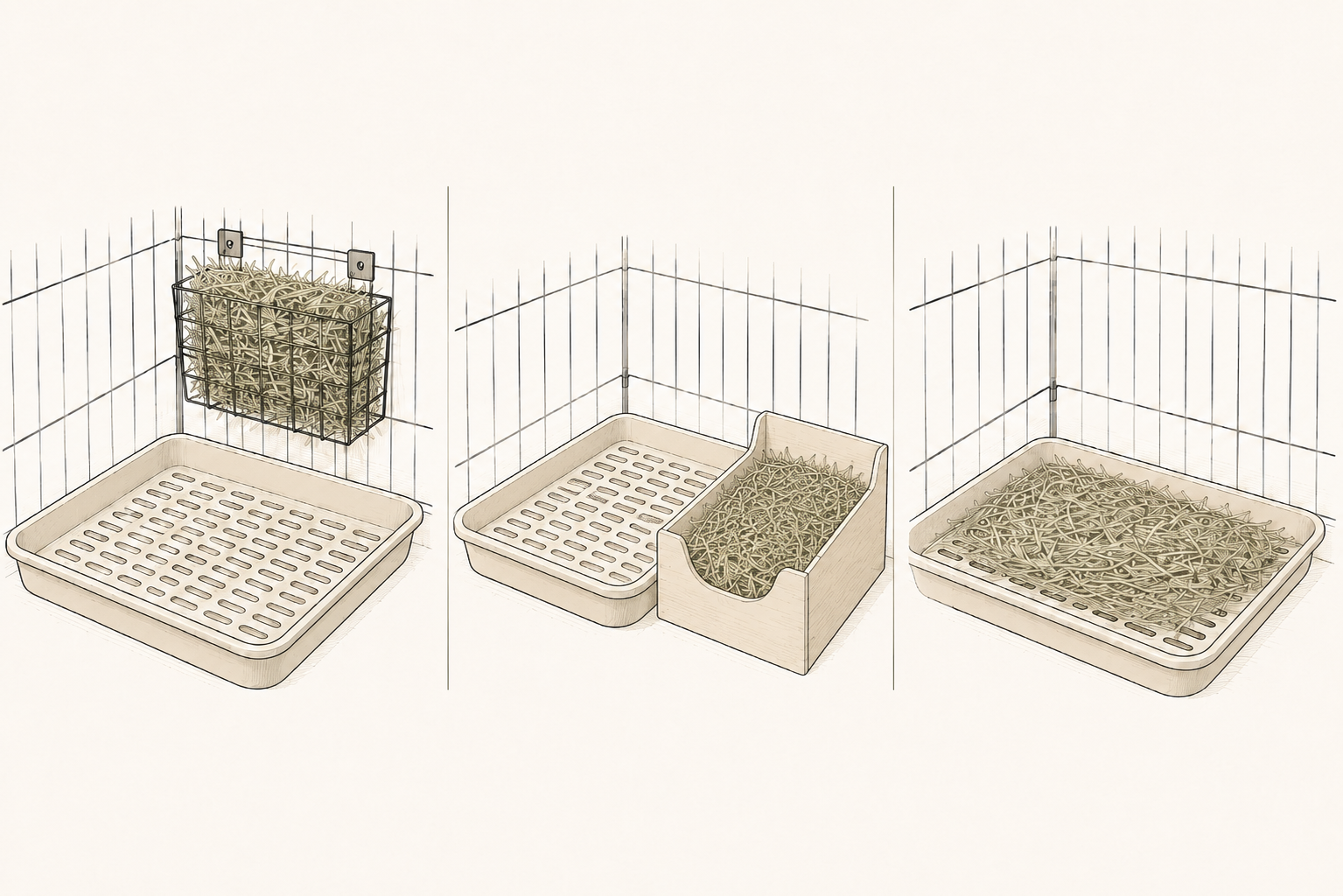
Common options include loose hay in the litter tray, a low hay box beside it, a hay rack or hay bag, and a secured bundle of hay.
Loose hay is the simplest and easiest for the rabbit to access, but it is also easy to scatter, trample and soil, so waste and cleaning can be higher.
A low hay box sits between loose hay and a traditional feeder. The rabbit can remain in the litter box and reach sideways into the hay without needing to lift the head much.
Hay racks and hay bags are often more convenient for owners, but design matters. Openings that are too small can create trapping risks for the head, toes or claws. Openings that are very large, or a completely open top, may encourage some rabbits to climb inside and even use the hay container as another toilet.
Some owners also group hay into a bundle and secure it near the litter area. This can reduce how much is pulled down at once, although the bundle may loosen as the rabbit eats through the middle or one side. If a clip is used, the rabbit should be able to reach the hay but not the clip itself.
Reducing Hay Waste Is Useful - but Hay Intake Comes First
Rabbits can be remarkably wasteful with hay. Pulling out a whole pile, choosing a few favorite strands and flattening the rest is common.
Even so, the first goal of a hay station should still be to make it easy and appealing for the rabbit to eat plenty of hay at any time.
If a very tidy feeder noticeably reduces how much hay your rabbit eats, it may not be the right setup for that rabbit. Some owners find that their rabbits eat more when hay is offered more loosely, even though the area becomes messier.
Hay is the foundation of a rabbit's diet, and consistent access to long-fibre forage is important for normal digestion and dental wear. Tidiness should not come at the cost of easy hay access.
Not All Grated Litter Surfaces Are the Same
You will often see the simple advice: never use a grate. That needs more context.
Thin wire flooring, metal mesh and narrow bars that concentrate pressure onto small areas of the feet are poor surfaces for rabbits, especially as long-term standing and resting surfaces.
Some owners, however, use hard plastic litter inserts with broad rounded supports and small circular holes. This structure is different from thin wire mesh: the feet are supported over a wider surface while droppings can fall through to the layer underneath.
There is no well-established rabbit-specific standard that tells us an exact safe hole diameter or support width for plastic inserts. It is therefore better to inspect the actual design: the supporting surface should be broad and smooth, openings should be clearly smaller than the rabbit's feet, toes and claws should not be able to catch easily, and the surface should not be excessively rough or slippery.
Even when this kind of insert is used, rabbits should always have plenty of solid, comfortable flooring elsewhere, and their feet should be checked regularly for redness, hair loss or pressure spots.
Choose Litter for Safety Before Anything Else
Low-dust, absorbent and non-clumping litter is usually the simplest choice.
Paper-based litter is easy to evaluate and widely used. Some properly processed wood pellets can also work well as litter, provided the product does not contain unsuitable fragrances, chemicals or additives.
It is generally better to avoid clumping cat litter, very dusty litter, fine sawdust, strongly scented products and loose fine materials that stick heavily to the coat.
Replace Soiled Hay When It Is Dirty
If hay is placed directly in the litter box, some of it will inevitably get wet. Remove clearly wet or soiled hay and replace it with fresh hay.
There is no need to force every household into exactly the same complete-cleaning schedule. One rabbit, two rabbits, a large box, a small box and different litter materials will all change how often the tray needs attention.
A more useful habit is to check every day
- is the surface still dry
- is any hay urine-soaked
- is the litter underneath saturated
- is there a strong smell
- does the rabbit still have a clean dry place to stand
Do Not Rush to Build the 'Perfect' Rabbit Litter Area
Rabbit setups on social media can look extremely polished: matching wooden furniture, hidden litter boxes, tidy hay feeders and barely a strand of hay out of place. They can be useful for inspiration, but they are not a standard you need to copy.
The most practical litter-and-hay area is usually something that develops over time. Watch which direction your rabbit prefers to eat from, whether they try to climb into the feeder, whether they like lying in the litter box, where hay gets pulled out and which areas become wet most often.
A good indoor rabbit litter-and-hay area does not need to look perfect. It needs to be large enough, easy to enter, easy to eat from, free from obvious trapping hazards, practical to clean and, most importantly, something your rabbit is actually comfortable using.
Sources and Further Reading
- Rabbit.org Foundation - Litter Training FAQ
- Rabbit.org Foundation - Litter Boxes
- Rabbit Welfare Association & Fund - Hay Racks
- Rabbit Welfare Association & Fund - How to Feed Rabbits
- Rabbit Welfare Association & Fund - Bedding and Litter
- PDSA - How to Litter Train a Rabbit
- RSPCA - Rabbit Dietary Enrichment
- RSPCA - Rabbit Environment
- Merck Veterinary Manual - Providing a Home for a Rabbit
- Rabbit.org Foundation - Treating Sore Hocks