How to Tell If a Rabbit Hay Feeder Is Actually Good to Use
A practical comparison of rabbit hay feeders, focusing on access, opening design, height, materials, shared use and everyday cleaning.
A hay feeder is not something every rabbit home has to use.
Some rabbits do perfectly well with hay placed directly in or beside the litter box. Other homes prefer a rack, bag or low hay box because it keeps more of the hay in one area and makes refilling easier. All of these can work. The real difference usually shows up in everyday use.
Two products can both be sold as “rabbit hay feeders” and feel completely different once a rabbit starts using them.
What a hay feeder actually needs to do
A hay feeder has a fairly simple job:
Hay should stay easy for the rabbit to reach, while refilling and cleaning remain easy enough for the owner.
If keeping the area tidy makes either of those things harder, the design is not really helping.
Easy access matters more than how much hay fits inside
A large feeder sounds convenient because it can hold a lot of hay at once. That does not always mean the rabbit can keep reaching it.
When hay is packed too tightly, the portion nearest the openings may be eaten first while the rest stays compressed further back. The feeder can still look full even though the rabbit can no longer pull much out.
Narrow openings can create a similar problem. Instead of pulling out a few strands, the rabbit has to tug hard and may bring out a whole bundle at once.
In that situation the feeder contains the hay, but it does not necessarily reduce waste.
Looser hay and openings that let it move naturally can be less tidy, but often make feeding much easier.
Hay is something rabbits return to throughout the day.
Being able to keep reaching it matters more than how impressive the feeder capacity looks.
Openings that are too small or too large can both be awkward
The openings are one of the biggest differences between feeder designs.
When they are very narrow, hay can be difficult to pull through, and small body parts such as toes, claws or the lower jaw may meet tight gaps. Fine metal grids and complicated wire structures are especially worth looking at closely if the rabbit likes to paw, climb or push against the feeder.
Very large openings have their own problems.
Some rabbits push the whole head through, then the front half of the body. Open-topped hay boxes can be even easier to climb into.
Once the rabbit can enter the feeder, hay is more likely to be trampled or used as a toilet.
There is no single opening measurement that suits every rabbit. Body size varies too much, and there is no widely accepted rabbit-specific number that guarantees safety.
A useful middle ground
Hay comes out without much effort, while the rabbit's head, feet and body are not encouraged into awkward gaps.
The feeder does not need to be high
Many hay racks are mounted above the litter box. It looks tidy, and loose pieces often fall straight into the tray.
A little height is not necessarily a problem. But if a rabbit has to lift the head sharply, stretch the neck or stand up on the front feet every time it eats, the position becomes less comfortable for something used so often.
Rabbits naturally spend a lot of feeding time with the head down or only slightly raised. Main hay is not an occasional enrichment toy; it is food they return to again and again.
A position that can be reached naturally while sitting or standing in the litter area is usually enough.
This becomes even more noticeable with older, larger or less mobile rabbits.
Different feeders tend to create different everyday problems
Once several types have been used, the differences are usually more practical than visual.
Metal hay racks
Metal racks are common, durable and generally easy to wipe clean.
The main difference is in the structure.
Some use thicker bars with simple spacing. Others are made from fine wire with many small gaps. More complicated gaps can give paws, claws or the lower jaw more places to catch when a rabbit paws at the hay.
Some racks are also poorly secured. A rabbit pulls hard and the whole feeder moves, rattles or comes loose.
The material itself is not the whole issue. Bar thickness, spacing, edges and fixing points matter just as much.
Fabric hay bags
Fabric bags are light, compact and easy to hang beside a pen or litter area.
The big variable is chewing.
Some rabbits ignore the fabric completely and only pull hay through the openings. Others chew the bag itself, gradually enlarging the holes and leaving loose threads around the edges.
Once the bag is being chewed regularly, the problem is no longer just durability. Fabric, threads and internal materials are not things a rabbit should be swallowing.
With this type of feeder, the rabbit's reaction to the bag matters as much as the product design.
Wooden hay feeders
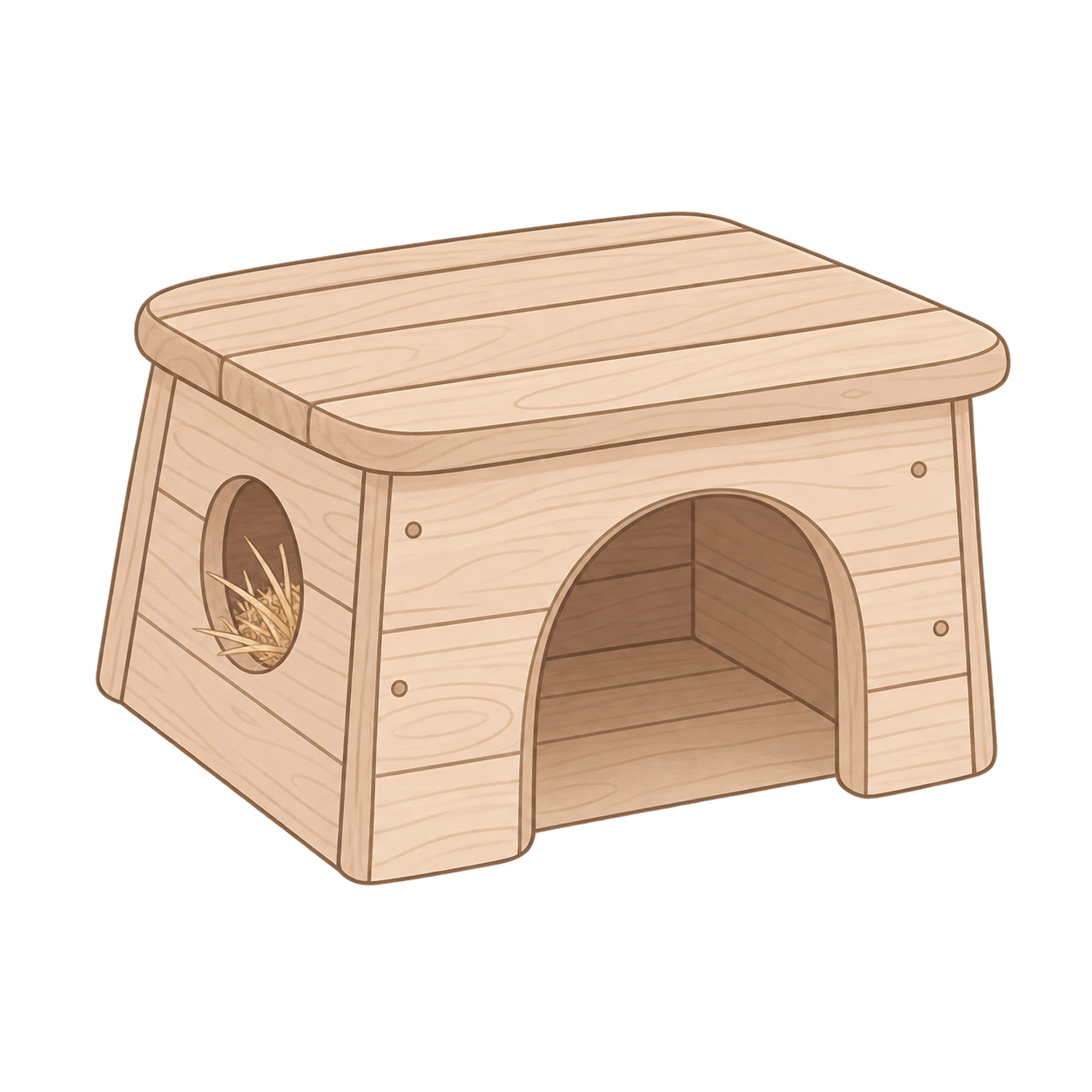
Wooden feeders often look more like furniture, especially when they are built into a litter-box station.
They are also very chewable.
If the wood is clearly suitable for rabbit contact and has no questionable coating, a little chewing may not be a major concern. The bigger uncertainty comes from products that do not clearly state what wood, paint, coating or adhesive has been used.
Wood is also harder to clean if urine repeatedly reaches it.
This type tends to work better when the hay compartment is separated from the wettest part of the litter area and the materials are clearly described.
Low hay boxes
A low hay box is one of the simplest setups.
There are fewer complicated openings, hay goes straight in, and the rabbit can eat from the top or side. Refilling is easy and the feeding position is natural.
The downside is just as obvious: hay can be pulled out, and some rabbits climb straight into the box.
For homes that strongly dislike loose hay, this may feel too messy. For homes that care more about easy access and do not mind sweeping a little, it can be simpler than a more elaborate rack.
A feeder can feel very different when two rabbits use it
A feeder that works well for one rabbit may feel much smaller once two rabbits eat at the same time.
A single narrow feeding opening makes it difficult to sit side by side. Bonded rabbits may not fight over it, but one rabbit can still spend a lot of time blocking the other.
A longer feeding edge, or two easy places to reach the same hay supply, tends to work better.
This is separate from total capacity.
A very large hay compartment with one tiny opening
still provides only one tiny feeding space.
Everyday refilling quickly shows whether a design is practical
A hay feeder is something that gets handled every day.
Some products look excellent when new, then become annoying because the top is too small to refill easily, broken hay collects in a corner that cannot be reached, or the whole feeder has to be removed before old hay can be cleaned out.
Small inconveniences become obvious when they repeat every day.
Simple designs are often easier to live with: hay can be dropped in from the top or back, old fragments can be removed, and the remaining amount is easy to see.
In day-to-day use, these are often the things that matter
- Does the rabbit have to pull unusually hard?
- Are there gaps where feet, claws or the body can get into awkward positions?
- After some hay is eaten, can the remaining hay still move toward the feeding area?
- Can two rabbits eat at the same time?
- Is daily refilling and cleaning straightforward?
None of these need a complicated scoring system. They usually become obvious after the feeder has been used for a while.
A good hay feeder usually does not draw much attention to itself
Product pages often focus on “large capacity,” “less waste” and “cleaner feeding.” Those features can be useful, but everyday experience usually comes down to smaller details.
The rabbit walks over and eats naturally. Hay remains available. Refilling is quick. The surrounding area is a little easier to manage, and the feeder does not constantly raise concerns about trapping, tipping or chewing.
If it works like that, it is already doing its job.
Whether it is the largest or the most attractive model matters much less.
A hay feeder does not need to be complicated.
The one that tends to stay in use is usually the one the rabbit accepts and the owner does not find annoying to maintain.
Sources and Further Reading
- Rabbit Welfare Association & Fund - Hay Racks: A helpful feeding tool or a recipe for disaster?
- RSPCA - Enhancing Your Rabbit's Diet
- RSPCA - Creating a Good Home for Rabbits
- Rabbit.org Foundation - Rabbit Litter Training FAQ
- Rabbit.org Foundation - Outdoor and Indoor Hazards
- Rabbit.org Foundation - The Importance of Hay